How salmon management policy based on scientific papers can be factually correct and misleading at the same time in recent years?
Executive Summary
The key point for anglers, the Minister, and Fish & Game is simple: the salmon genetics debate has confused facts, assumptions, and policy language. Selective breeding is not creating a GMO, and NCFG has not created a new genetically modified salmon breed, nor has anyone else. Hatchery origin does not prove genetic weakness in Canterbury rivers. Claims and poor communication by NCFG, CSIFG, and others must be tested against evidence, not repeated until they sound scientific.
- No GMO (genetically modified organism) salmon have been released into Canterbury rivers. It’s illegal to do so in NZ. Any suggestion otherwise needs. to be reported to MPI.
- Selective breeding is normal animal management. It is not genetic modification.
- All New Zealand Chinook salmon originated from imported Californian hatchery eggs. Hatchery ancestry is therefore unavoidable in Canterbury.
- Self-sustaining river populations have existed for more than a century. These fish have lived, survived, and bred under natural river selection because of local natural optimisation to the catchment.
- The term “hatchery” should not be used as shorthand for genetic weakness without evidence.
- Science may support distinctions between natural-spawned and hatchery-reared fish, but policy claims must not turn assumptions into facts.
- Using supportive breeding programs, such as Mc Kinnons Creek are the way forward to replace the baby salmon lost to nonconsenting fish screen facilities (FSF). FSF that can’t return baby salmon promptly back to the river unharmed also need to be replaced
- The onus is on NCFG and CSIFG to fund supportive breeding programs until it successfully seeks redress for the all the lost baby salmon lost over the last 30 years.
- To increase returning salmon numbers, marked eggs and smolt should be released in headwaters under a controlled ten-year programme comparing hatchery-sourced fish with natural spawners based on expert advice.
- Anglers, commercial salmon interests, and responsible Ministers are entitled to direct answers on GMO by NCFG and CSIFG claims, hatchery policy, wild salmon definitions, and future salmon management.
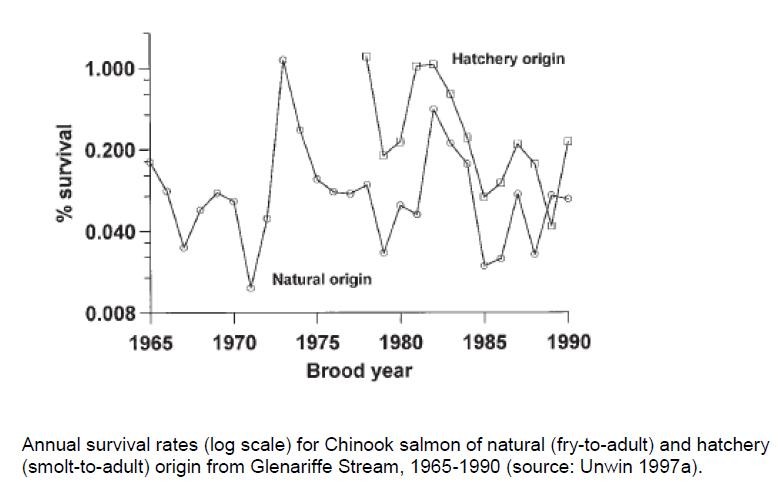
- The lack of clarity combined with poor continued communication from FG has lost sight that based on known NZ science hatchery smolt have higher survival rates that natural spawners
When you read this document (and all the information you receive), you first need to assess how the information/ scientific papers can be factually correct and misleading at the same time?
Step 1 You take a fact.
Step 2 You connect the fact with an assumption.
Step 3 The assumption is now a fact through science if stated enough through comms.
The assumption is that hatchery fish from wild stock are genetically deficient. But that claim needs to be tested against the facts. All New Zealand salmon came from imported Californian hatchery stock. Anglers did not import live salmon in the early 1900s; they imported eggs. Some eggs were planted directly into streams, much like an early version of Scotty boxes, while others were hatched in hatcheries before release into different rivers.
Two recognised salmon experts have confirmed that New Zealand salmon were imported this way. That means there is a spectrum of hatchery influence, from hatchery fish released soon after hatching too fish descended from salmon that have lived and bred in rivers for many generations. If New Zealand science says hatchery smolt outperform wild smolt, then that point should be central to any plan to Rewild the Canterbury salmon fishery for anglers.
So why are NCFG and CSIFG making claims about genetically modified, or GMO, salmon? That is for them to explain to anglers. Commercial salmon operators, Fonterra, dairy farmers, and the Minister responsible for Fish & Game are entitled to clear answers about those statements. Anglers are entitled to the same answers.
The basics
Genes are made of DNA. DNA usually changes very slowly over time. Small changes can matter, and some harmful changes may reduce survival. However, most differences we see within a species are not caused by completely new DNA appearing. They are usually caused by existing DNA being mixed, inherited, selected, or expressed in different ways. For example, green, gold, red, and yellow kiwifruit are different varieties, but that does not automatically mean they are genetically modified. A genetically modified organism is usually made by deliberately changing or inserting DNA in a laboratory. In New Zealand, genetically modified food production is tightly controlled and generally not allowed for commercial release.
A simple way to understand this is to think about black sheep and white sheep. A black sheep does not have “bad” DNA, and a white sheep does not have “good” DNA. They are the same species and carry the same basic DNA. The difference is that a farmer can choose which sheep to breed from. If the farmer keeps selecting black sheep, then over time the flock will contain more black sheep and fewer white sheep. If black and white flocks are kept separate, their colours stay separate. If the flocks are mixed, the next generations will show a wider mix of colours and shades. This is selective breeding. New Zealand farmers understand this well because they have used selection for many years to improve stock. That knowledge has helped give New Zealand a strong position in world markets. However, if valuable plant and animal breeding stock is sold overseas, that advantage may become harder to protect.
There have been no GMO salmon released into Canterbury rivers. A useful comparison is the dairy industry, which is worth more than $20 billion. Dairy farmers use selective breeding to improve their herds. They choose cows that turn grass into milk solids efficiently, then breed from those cows. This improves milk production without genetically modifying the animals using selective breeding techniques.
Genetic modification (GMO animals or plants to eat or drink) is different because it uses laboratory techniques to change or insert DNA. If dairy farmers used that approach, the cows would be genetically modified, and the industry would go bust as consumers would reject GMO milk solids placing $20+ B industry at risk. The salmon industry works in the same basic way. It uses selective breeding, not GMO techniques, to improve stock. If commercial salmon producers used GMO methods they would risk damaging the value and reputation of the industry on disclosure. This would put a further $500M industry at risk due to poor communication.
Fortunately, anglers already have the strongest selective breeding system available toma kind: nature. Salmon with weaknesses usually do not survive long enough to breed. This means the lack of rigour in a natural environment where the survival of the fittest is used prevents the weaknesses being passed on to the next generation. This process has been going on for more than 70,000 years as salmon continue to evolve to meet changing environmental conditions.
Genes are sections of DNA. The DNA itself is passed from parents to offspring, but not every part of that DNA is used in the same way all the time. Some parts can be switched on or off depending on the animal’s environment and stage of life. Salmon are naturally adaptable fish. They respond quickly to local conditions in each river. Young salmon, called smolt, are also opportunistic feeders as they move downstream toward the sea. This ability to feed widely and adjust quickly helps explain how salmon have spread into different South Island rivers and survived there. Humans are no different.
Did You know?
Even though the genetic makeup might be the same across regions, their expression (whether they’re turned “on” or “off”) differs.
The term genotype refers to the genetic makeup of an organism. Genome means the full set of genes of an organism. The term also can refer to the two alleles inherited for a particular gene. The genotype is expressed when the information encoded in the genes’ DNA is used to make protein and RNA molecules. The expression of the genotype contributes to the individual’s observable traits, called the phenotype. A lot of effort has gone into identifying the genetic landscape of pancreatic cancer in recent years. One of the key goals of pancreatic cancer research in the coming years will be to correlate genotype with phenotype characteristics by combining large-scale genomic, transcriptomic, proteomic, and metabolomic data based on the pancreatic cancer genome map.
Genotype
In a broad sense, the term “genotype” refers to the genetic makeup of an organism; in other words, it describes an organism’s complete set of genes. In a more narrow sense, the term can be used to refer to the alleles, or variant forms of a gene, that are carried by an organism. Humans are diploid organisms, which means that they have two alleles at each genetic position, or locus, with one allele inherited from each parent. Each pair of alleles represents the genotype of a specific gene. For example, in sweet pea plants, the gene for flower color has two alleles. One allele codes for purple flowers and is represented by the uppercase letter F, whereas the second codes for white flowers and is represented by the lowercase letter f. A varied population of sweet pea plants could therefore feature three possible genotypes at this locus: FF, Ff, or ff. Each plant’s genotype contributes to its phenotype, which, in this case, is the outward appearance of its flowers. A particular genotype is described as homozygous if it features two identical alleles and as heterozygous if the two alleles differ. The process of determining a genotype is called genotyping.
Human DNA
Genes consist of DNA, which determines what an organism is like, its appearance, how it survives, and how it behaves in its environment. All living beings have genes, which can also determine a person’s health throughout their life.
Different organisms have different numbers of genes. The human genome, which is all human genes together, contains about 30,000 genes.
All humans are 99.9% identical across their human genome, with only minor genetic differences leading to visible physical differences.
These differences, which may be inherited or result from the interaction between a person’s genes and the environment, can also explain why some people develop certain diseases and others do not.
A geneticist studies genes and how to target them to improve aspects of life. Genetic engineering can provide benefits, including preventing some human diseases.
What are genes?
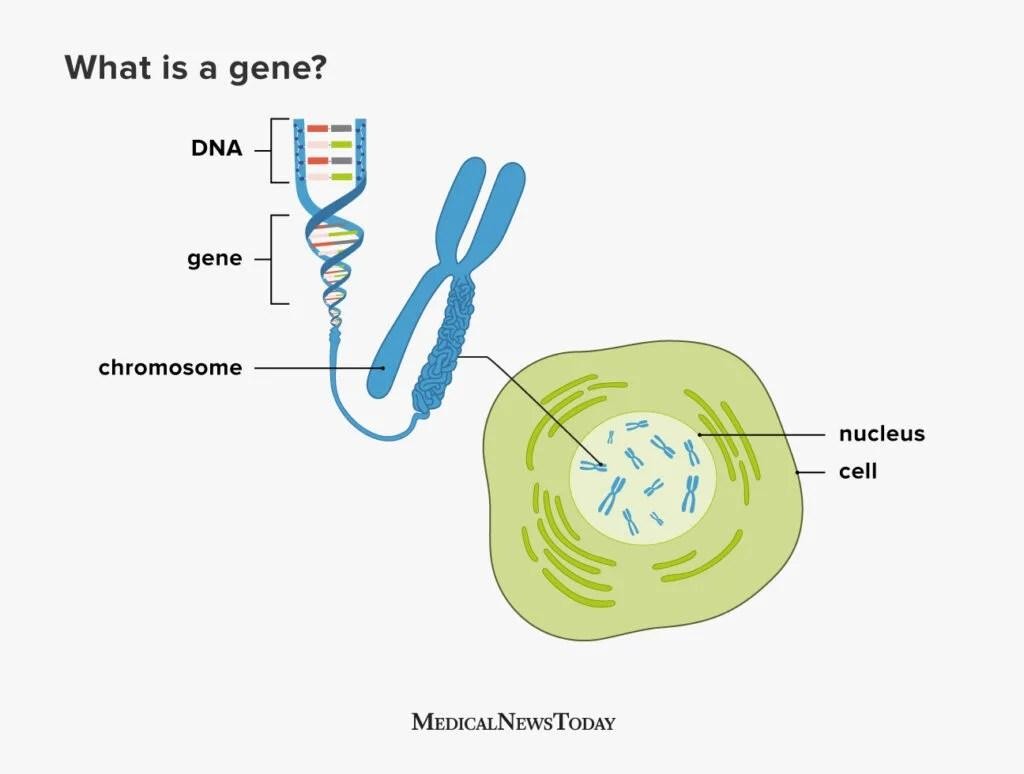
Genes are strands of DNA that contain the biological instructions for life. Each gene contains sequences that determine physical and biological traits. Medical illustration by Bailey Mariner
Genes are composed of deoxyribonucleic acid, or DNA. DNA contains the biological instructions that allow life to develop, grow, and reproduce.
Chromosomes, located in each cell’s nucleus, contain genes. Each gene contains DNA sequences that provide instructions for making specific proteins.
These proteins lead to visible physical characteristics such as hair colour, height, and eye colour. They can also affect a person’s risk of developing certain genetic disorders.
DNA passes from adult organisms to offspring during reproduction, so people inherit gene-containing chromosomes from their parents.
Chromosomes come in pairs. Humans have 46 chromosomes: 23 inherited from the mother and 23 from the father.
DoC runs hatcheries for native birds such as kiwi. It takes wild stock, hatches the young, and releases them back into the wild. I have not heard anyone argue that these hatchery birds are genetically deficient, or that releasing them changes the DNA of the wild population. Nor is anyone arguing that they are GMO Kiwis.
So why the big debate about salmon? Nature is unforgiving. Animals with poor fitness usually do not survive for long. The fish world is even harsher: larger fish eat smaller fish, whether they are in freshwater or saltwater. In the end, salmon survival depends on fitness, not on whether an animal came from a hatchery or a natural spawner.
The paper below was accepted by the National Fish & Game salmon committee and helped shape the Clutha salmon Rewilding project. If hatchery support was accepted for Clutha, why has NCFG not reinstated hatcheries in its current salmon management plan instead of relying on seasonal bag limits that reduce Angler opportunity?
Hatchery support could help rebuild a sustainable angler fishery, meet the Minister’s expectation of salmon anglers returning to rivers, and align with NCFG’s commitment to put boots on the ground and Rewild the salmon fishery.
‘WILD SALMON’ AND ‘HATCHERY REARED WILD STOCK’
Draft Preliminary Report to Sea Run Salmon Committee
Rick Boyd
September 2018
Introduction
Discussion arose about ‘wild’ salmon and ‘hatchery reared wild stock’ at the Committee’s meeting of 14 September. This included whether hatchery reared salmon originating from parents taken from the wild, raised in the hatchery and released as juveniles, constituted ‘wild’ salmon and/or what exactly was meant by ‘hatchery reared wild stock’. It was agreed I would look at the literature on this subject and prepare a paper for the Committee.
This paper does not address the efficacy of using salmon sourced from the wild as brood stock in hatcheries to help rebuild ‘wild’ salmon populations. That is being addressed in a separate paper which is still in preparation.
What is a Wild Salmon?
All New Zealand salmon are the progeny of salmon originally raised in a hatchery or artificial
environment. Fertilised eggs were imported into the country, incubated, and reared prior to release into New Zealand rivers. Given that background, there are no salmon present in New Zealand rivers that were not hatchery bred/reared at some time in their past.
If one takes an extreme position that a truly wild salmon must be one that has no hatchery ancestor, then it can be argued that there are no wild salmon in New Zealand. However, there are natural selfsustaining salmon populations in New Zealand rivers that have been present for more than a century. While they may have ancestors from a hatchery and/or artificial rearing environment, these selfsustaining New Zealand salmon populations are now in almost all respects ‘wild’ as they live and reproduce entirely in a natural environment. After more than a century, there are observable biological, physical, and genetic differences between the salmon populations in different rivers. In the New Zealand context at least, these salmon populations that live and reproduce in the natural environment are wild salmon.
Why Distinguish Wild Salmon from Hatchery Salmon?
There is a growing body of research that shows that the progeny of hatchery-bred and reared salmon perform quite differently and have different biological and genetic characteristics in a number of important respects when compared to the progeny of salmon that breed naturally and rear entirely in the wild. Therefore, in evaluating salmon management options, including the potential role of hatcheries for rebuilding depleted ‘wild’ salmon populations and/or supplementing recreational salmon fishing using hatcheries, it is important to have agreed criteria or definitions for distinguishing between ‘wild’ and ‘hatchery’ salmon.
In reviewing the scientific literature it is clear that there is no simple way to distinguish what might be considered as a wild salmon from a hatchery-origin salmon. On the west coast of North America, hatchery production of salmon is so extensive that it is considered that there are few, if any, naturally spawning salmon populations that have not had at least some mixing with hatchery origin spawners. Courtier & Lackey (2006) provide a thoughtful and very useful paper on defining wild salmon. They point out that there is no consensus on what constitutes a wild salmon except on a relatively superficial basis. They propose that the choice of a definition for wild salmon is largely a policy decision that uses science as one of the criteria. They suggest that within the spectrum of choices, the following definitions of ‘wild salmon’ could be adopted, depending on the circumstances and the policy objective:
- Any salmon, none of whose ancestors had ever been held in captivity. (Type 1)
- Any salmon spawned naturally and whose parents spawned naturally. (Type 2)
- Any salmon spawned naturally. (Type 3)
- Any salmon spawned from locally-based gene pools. (Type 4)
- Any free-living salmon. (Type 5)
The first three (Types 1, 2 and 3) are defined on heredity alone. Clearly, there are no Type 1 wild salmon in New Zealand. The self-sustaining populations of salmon in New Zealand rivers are primarily Type 2, although in most rivers it is likely with some Type 3 individuals mixed in (progeny of hatchery reared parents that spawned naturally in the wild).
The definitions for Type 4 and 5 do not appear to be particularly useful in the New Zealand context as they do not distinguish between hatchery reared salmon and naturally spawned salmon. There is a recognition of the value of maintaining self-sustaining salmon populations in our rivers and neither of these definitions capture that. It will be more useful to have a definition of wild salmon in New Zealand that clearly distinguishes them from hatchery reared salmon. The Type 2 definition above is arguably the best at doing that.
Hatchery Reared Wild Stock?
On the basis that it is accepted that the definition of ‘wild’ salmon is either a Type 2 or Type 3 salmon, it is not possible to to consider any hatchery reared fish as ‘wild’.
On first appraisal, it could be argued that hatchery reared wild stock are the progeny of salmon taken from the wild (on their way to or at their natural spawning grounds) and bred and raised in the hatchery until release – and thus they are of ‘wild’ origin with predominantly ‘wild’ characteristics. However, these fish would not be wild salmon according to either the Type 2 or Type 3 definitions discussed above. They are hatchery produced salmon, not fish that are the product of natural spawning and rearing in the wild. If these hatchery-produced salmon returned to spawn and were left to spawn in the wild, their progeny would meet the Type 3 definition. In another generation of spawning in the wild, their progeny would be Type 2 wild salmon.
Science does not support the view that hatchery raised salmon from ‘wild’ parents have wild characteristics. Even a single generation in captivity can result in substantial changes in their genetics and biological traits (Christie et al. 2011, Christie et al. 2014). For this reason, it seems inappropriate to ever incorporate the word ‘wild’ when describing salmon raised in a hatchery.
However, there may very well be quite valid reasons to source brood stock for a hatchery from ‘wild’ stock from time to time. That is not in question. But the science indicates that the resulting hatchery fish, even with ‘wild’ parents, will not have the same genetic makeup or biological characteristics of wild fish. These genetic and biological characteristics are crucial as they affect survival and reproductive success in the natural environment. So, it is extremely important to maintain a clear distinction between hatchery origin fish and wild fish when developing management strategies for rebuilding natural self-sustaining populations of salmon.
Overall, it is my opinion that using the term ‘hatchery reared wild stock’ presents an illusion of wildness when it does not in fact align with scientific knowledge about the significant differences between hatchery fish and naturally spawning fish. While the parental origin may be from ‘wild’ salmon, there is a substantial and growing body of research that shows the biological and genetic characteristics of hatchery produced salmon are significantly different from salmon that are the direct progeny of naturally spawning salmon, irrespective of parentage. There is also evidence that mixing of hatchery origin salmon with ‘wild’ salmon on the spawning grounds may be damaging to reproductive success of the wild population (Chilcote et al. 2011). This emphasises the need to clearly distinguish between the two, both in policy development and in practice in the field.
Avoiding use of the term ‘hatchery reared wild stock’ will assist in that – they are simply hatchery reared salmon with a known parental background. Simply put, there is no such thing as a hatchery reared wild salmon.
Recommendations
- Note that this paper is a preliminary draft for initial comment.
- That this Committee agree that it is important to clearly and unequivocally distinguish between wild salmon and hatchery salmon because of their significant genetic and biological differences.
- That this Committee adopt the Type 2/31 definitions of ‘wild salmon’ as the most appropriate for its future work in developing policies for restoring natural self-sustaining populations of Chinook salmon in New Zealand rivers, using the definitions provided by Courtier & Lackey (2006).
- That this Committee does not use or support using the term ‘hatchery reared wild stock’ and that in its future work identify all salmon as either ‘wild salmon’ or ‘hatchery salmon’.
It is not always possible or practical in the field to distinguish between fish are the progeny of parents that spawned naturally (thus are Type 2) from fish that are the progeny of hatchery reared parents (thus are Type 3) unless all the hatchery-origin are marked. This is primarily a management matter and can be addressed in the future. However, preventing hatchery reared fish (Type 3) intermingling with wild fish (Type 2) on spawning grounds is arguably important in restoring and maintaining ‘wild’ salmon populations.
References
Chilcote MW, Goodson KW, Falcy MR (2011). Reduced recruitment performance in natural populations of anadromous salmonids associated with hatchery-reared fish. Canadian Journal of
Fisheries and Aquatic Sciences. 68:511-522
Christie, M. R., M. L. Marine, R. A. French, and M. S. Blouin (2012). Genetic adaptation to captivity can occur in a single generation. Proceedings of the National Academy of Sciences 109:238–242 Christie MR, Ford MJ, Blouin MS (2014). On the reproductive success of early-generation hatchery fish in the wild. Evolutionary Applications 7:883–896
Courter II, Lackey RT (2006). Defining what constitutes a wild salmon. Annual Meeting, Oregon Chapter, American Fisheries Society, March 1-3, Sunriver, Oregon.
So what are the assumptions, what are the facts, what assumptions have been turned into facts by NCFG and CSIFG through communication to Anglers about salmon hatcheries in your view as an Angler?
Paul Hodgson
President NZSAA
there is new science from America around Hatchery and wild salmon basically saying that every North Pacific salmon has some form of hatchery in its genetic makeup . their reasoning is that around 8 billion salmon smolt are released into the area from all countries surrounding the top of the Pacific. It has been going on for over 120 years. Global warming has also been used , However judging by the comeback and size of salmon particularly chinook though there have been massive runs of sockeye, salmon are adapting to the conditions. Alaska is the anomaly but has a huge trawler bycatch problem. think there needs to be a serious rethink about our salmon here. there are ways and finance to fix this but it seems NCF&G and CSI are not interested as it does not suit their agenda . and they might think they are losing their management control but the government according to the Conservation Fresh Water Act own all trout and salmon in in rivers and lakes and even farm water storage ponds.