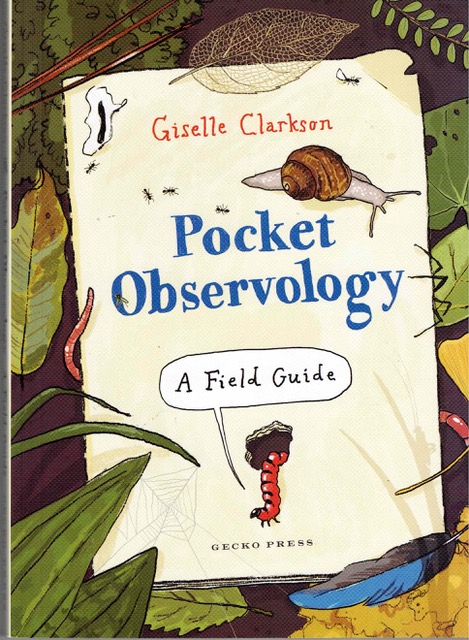
Book review: “Pocket Observology; A Field Guide by Giselle Clarkson, published by Gecko Press, price $27.99
reviewed by Tony Orman.
There’s no doubt about the benefits of getting kids outdoors, hopefully of a prelude to taking up fishing. In any case, get the youngsters away from mobile phones and the internet’s social media’s muck and instead develop and nurture an empathy for the natural world.
Wairarapa author and illustrator Giselle Clarkson already and established author in this field, has written and illustrated a book designed to encourage that interest outdoors. It is an ideal gift for children and grandchildren whichever the case may be.
And a wee bonus, in encouraging and supervising their youngsters exploration of the natural world about them, adults are also likely to learn a few things from this amazing book.
I noted the cicada according to the author lays its eggs in “a slit in a tree branch”. That may be so but I always believed the larva lived in the ground for several years before hatching. According to AI, cicadas in New Zealand spend three years underground. I thought it more like several years. Is AI wrong? Do the hatched cicadas from the tree branch then wend their way to their underground larva stage? There it’s aroused my curiosity.
This book is so good and the communication to a young reader is enhanced by the author using expressions young folk might use such as describing the function of a fly’s maggot as “essential for ridding the world of dead stinky things.” Add frequent touches of humour such as a worm coiling up when you try to pick it up, saying “Argh, something touched me. Stop! Stop it! Leave me alone.”
Which leads to an admirable section towards the end of carefully releasing creatures such as helping an exhausted bee, relocating a spider, protecting a fledgling bird preparatory to release or releasing a worm by gently scooping it onto something like a flat leaf. “Don’t pick up a worm between your fingers — It’s too easy to squish it.”
What a contrast to the pest competitions, some Kiwi schools stupidly hold with the emphasis on kill, kill, kill.
The book is beautifully produced by the publisher and in a practical sturdy style so that a youngster can slip the guide into a pocket and set out on small scientific forays just around the home and garden.
The book serves as a quick reference to identification with various creatures such as how to tell a wasp from a bee and a cricket from a grasshopper.
Such is the attributes of this gem of a field guide that it’s bound to awaken kids’ curiosity to the natural world.
Very highly recommended. Get a copy for all your family’s youngsters!
!